
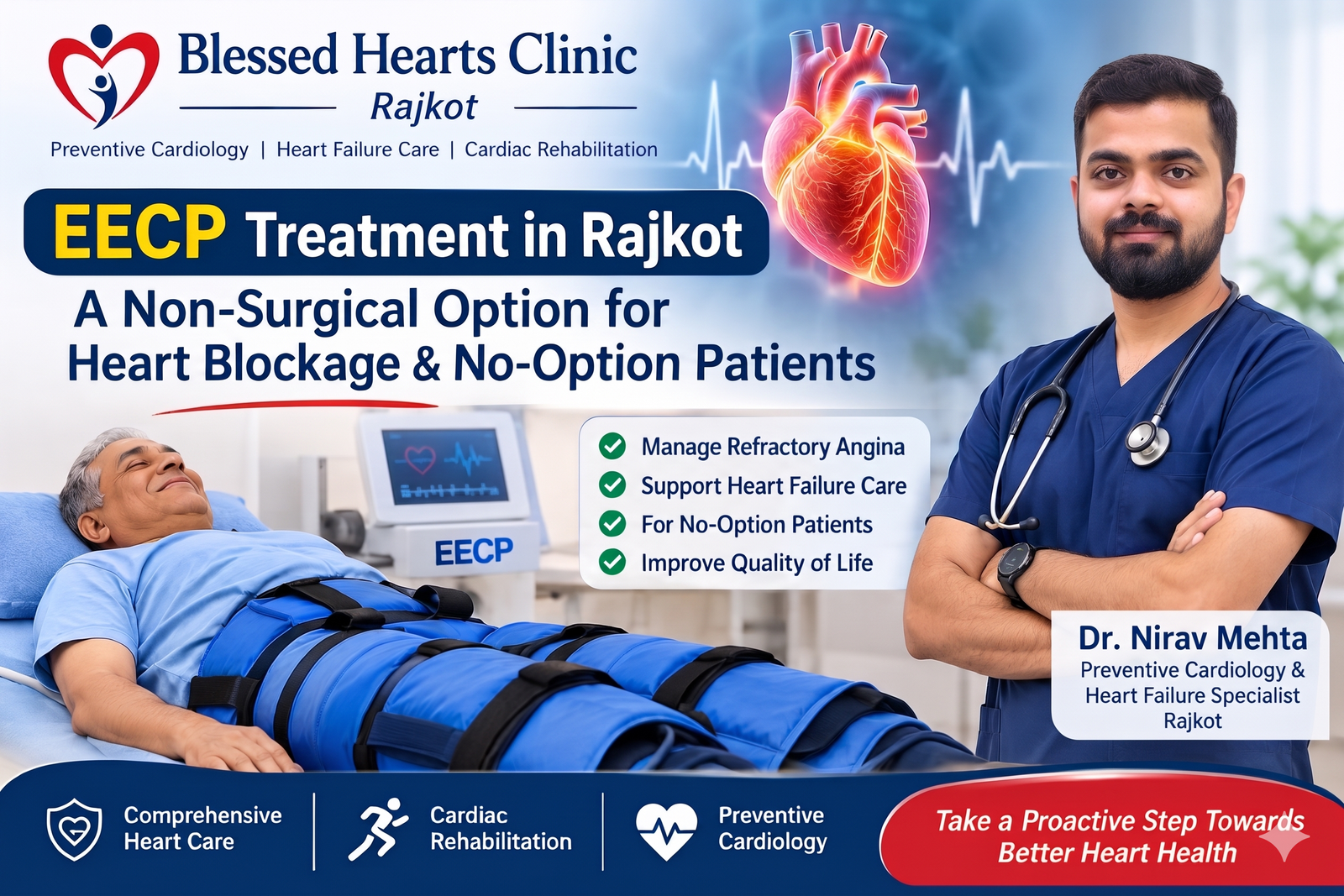
Heart disease can become challenging when patients continue to experience chest pain, breathlessness or reduced exercise capacity despite medications, angioplasty or bypass surgery.
Some patients have diffuse coronary artery disease, recurrent angina after multiple interventions or medical conditions that make further surgery or angioplasty unsuitable. These patients are often described as having “no-option” coronary artery disease.
For carefully selected patients, Enhanced External Counterpulsation (EECP) offers an important non-invasive treatment option, particularly for managing refractory angina.
At Blessed Hearts Clinic, Rajkot, Dr. Nirav Mehta focuses on preventive cardiology, heart failure management, cardiac rehabilitation and non-invasive cardiovascular therapies, including EECP.
Meet Dr. Nirav Mehta – Preventive Cardiology and Heart Failure Specialist in Rajkot
Dr. Nirav Mehta is the Clinical Director of Blessed Hearts Clinic, Rajkot. His clinical focus includes preventive cardiology, heart failure management, cardiac rehabilitation and the management of patients with complex cardiovascular conditions.
His approach emphasises comprehensive cardiovascular care, particularly for patients who continue to experience symptoms despite conventional cardiac treatment.
His areas of clinical focus include:
-
Preventive cardiology and cardiovascular risk-factor management.
-
Heart failure management and functional improvement.
-
Care of patients with advanced coronary artery disease.
-
Evaluation and management of patients with refractory angina.
-
Non-invasive treatment options for selected no-option cardiac patients.
-
EECP therapy following appropriate cardiovascular assessment.
-
Cardiac rehabilitation after angioplasty and bypass surgery.
-
Lifestyle modification and long-term cardiovascular risk reduction.
The objective is to help patients explore appropriate treatment options while maintaining the highest priority on evidence-based medical management.
Who Are No-Option Heart Patients?
Not every patient with coronary artery disease can undergo another angioplasty or bypass operation.
No-option patients may include:
-
Patients with diffuse coronary artery disease that is unsuitable for further intervention.
-
Patients with recurrent chest pain despite previous angioplasty and stenting.
-
Patients with persistent angina after coronary artery bypass surgery.
-
Patients with multiple previous coronary interventions.
-
Patients in whom further revascularisation is considered unsuitable after specialist evaluation.
-
Patients with refractory angina despite optimal medical treatment.
These patients may experience significant limitations in everyday activities, exercise capacity and quality of life.
For appropriately selected patients with refractory angina, EECP may offer an additional non-invasive treatment option.
EECP – An Important Treatment Option for No-Option Cardiac Patients
Enhanced External Counterpulsation (EECP) is a non-invasive cardiovascular therapy that aims to improve coronary perfusion and reduce symptoms of chronic stable angina.
It is particularly relevant when a patient continues to experience angina despite medical treatment and has limited or no suitable options for further coronary revascularisation.
During EECP treatment:
-
Special pneumatic cuffs are placed around the calves, thighs and buttocks.
-
The cuffs inflate sequentially during the diastolic phase of the cardiac cycle.
-
This increases diastolic pressure and may improve blood flow towards the coronary circulation.
-
The cuffs rapidly deflate before systole, reducing the resistance against which the heart pumps.
Repeated treatment sessions may produce beneficial haemodynamic and vascular adaptations.
Why Consider EECP for No-Option Patients?
For selected patients with refractory angina, EECP can be considered when conventional revascularisation options have been exhausted or are unsuitable.
Potential benefits include:
-
Reduction in angina frequency.
-
Improvement in exercise tolerance.
-
Reduced dependence on short-acting anti-anginal medication in some patients.
-
Improvement in quality of life.
-
Better functional capacity.
For carefully selected no-option patients with refractory angina, EECP may be one of the important remaining non-invasive treatment options worth evaluating.
It does not remove coronary artery blockages or replace necessary emergency cardiac treatment.
EECP After Angioplasty and Bypass Surgery
Some patients continue to experience chest pain even after successful angioplasty or bypass surgery.
Possible reasons include residual coronary artery disease, diffuse small-vessel disease, progression of atherosclerosis or coronary microvascular dysfunction.
After appropriate evaluation, EECP may be considered for patients with persistent chronic angina.
A detailed cardiovascular assessment is essential before recommending treatment.
Heart Failure Management in Rajkot
Heart failure is a complex cardiovascular condition in which the heart cannot adequately meet the body’s circulatory requirements.
Patients may experience:
-
Breathlessness during routine activities.
-
Fatigue and reduced exercise capacity.
-
Swelling of the legs.
-
Difficulty lying flat due to breathlessness.
-
Recurrent hospital admissions.
Modern heart failure management involves more than prescribing medication. It requires a comprehensive approach that includes:
-
Appropriate guideline-directed medical therapy.
-
Assessment of cardiac function and ejection fraction.
-
Blood pressure and diabetes management.
-
Monitoring of fluid status and symptoms.
-
Nutritional and lifestyle guidance.
-
Structured cardiac rehabilitation where appropriate.
-
Regular assessment of functional capacity.
At Blessed Hearts Clinic, Dr. Nirav Mehta focuses on comprehensive heart failure care, functional assessment and rehabilitation-oriented management.
Can EECP Help Patients with Heart Failure?
EECP has been studied as an adjunctive therapy in selected patients with chronic heart failure.
Some studies suggest potential improvements in exercise tolerance and quality of life. However, evidence remains limited, and EECP is not an established replacement for guideline-directed heart failure treatment.
Its suitability must be determined individually, particularly in patients with advanced heart failure or fluid overload.
Is EECP an Alternative to Angioplasty or Bypass Surgery?
EECP and coronary revascularisation serve different purposes.
Angioplasty and bypass surgery aim to restore blood flow by treating obstructive coronary artery disease.
EECP aims to improve symptoms and functional capacity through haemodynamic and vascular effects.
It is particularly worth considering in selected patients with refractory angina who are unsuitable for further revascularisation.
It must never delay indicated angioplasty or bypass surgery, or emergency treatment for acute coronary syndrome.
How Many Sessions of EECP Are Required?
A conventional EECP course generally consists of:
-
35 treatment sessions.
-
Approximately one hour per session.
-
Five to six sessions per week.
-
Approximately seven weeks for completion.
The treatment is non-invasive and generally performed while the patient is awake and resting comfortably.
Preventive Cardiology: Treating the Disease and Preventing Its Progression
At Blessed Hearts Clinic, cardiovascular care extends beyond treating existing blockages.
Preventive cardiology focuses on identifying and controlling cardiovascular risk factors to reduce future cardiac complications.
Important components include:
-
Cholesterol and lipid management.
-
Diabetes control.
-
Blood pressure management.
-
Weight management.
-
Heart-healthy vegetarian nutrition.
-
Smoking and tobacco cessation.
-
Regular physical activity.
-
Structured cardiac rehabilitation.
-
Long-term cardiovascular risk assessment.
For patients with established coronary artery disease, these interventions remain essential even after angioplasty, bypass surgery or EECP treatment.
Why Choose Blessed Hearts Clinic for EECP and Cardiac Rehabilitation in Rajkot?
Blessed Hearts Clinic focuses on comprehensive, patient-centred cardiovascular care.
Our areas of focus include:
-
EECP therapy for appropriately selected patients.
-
Preventive cardiology.
-
Heart failure management.
-
Assessment of patients with refractory angina.
-
Non-invasive treatment options for selected no-option cardiac patients.
-
Structured cardiac rehabilitation.
-
Lifestyle modification and cardiovascular risk management.
Our philosophy is to explore appropriate treatment options even in patients with complex cardiac conditions while maintaining evidence-based medical care.
Frequently Asked Questions
1. Who is a no-option heart patient?
A no-option patient is generally someone with severe or diffuse coronary artery disease for whom further angioplasty or bypass surgery is not considered suitable. Some of these patients may be evaluated for EECP if they have refractory angina.
2. Can EECP help patients who have undergone multiple angioplasties?
Selected patients with persistent chronic angina after multiple coronary interventions may benefit from an EECP suitability assessment.
3. Is EECP useful for patients who cannot undergo bypass surgery?
EECP may be considered for selected patients with refractory angina who are not suitable for further coronary revascularisation.
4. Can EECP improve heart pumping function?
Some studies have reported improvements in cardiac functional parameters, but improvement in ejection fraction is not guaranteed.
5. Can patients with heart failure undergo EECP?
Some carefully selected patients with stable chronic heart failure may be considered. However, EECP is not a standard substitute for heart failure medication or other indicated therapies.
6. Where can I get EECP treatment in Rajkot?
Blessed Hearts Clinic provides EECP therapy, preventive cardiology and cardiac rehabilitation in Rajkot. Contact the clinic for a cardiovascular assessment.
Consult Dr. Nirav Mehta – Blessed Hearts Clinic, Rajkot
If you or a family member has persistent chest pain, coronary artery disease, heart failure, recurrent symptoms after angioplasty or bypass surgery, or has been told that no further intervention is possible, a comprehensive cardiovascular assessment may help identify appropriate treatment options.
Dr. Nirav Mehta
Preventive Cardiology Specialist | Heart Failure Specialist | No-Option Cardiac Patient Care
Clinical Director – Blessed Hearts Clinic
Blessed Hearts Clinic
209, 2nd Floor, The Spire 1 Building,
Above Parin Tata Motors Showroom,
Near Shital Park BRTS, 150 Feet Ring Road,
Rajkot, Gujarat – 360006.
Website: https://blessedhearts.in
Appointments: 9664634126 / 9825360258
Blessed Hearts Clinic – Preventive Cardiology | Heart Failure Care | EECP Therapy | Cardiac Rehabilitation
When conventional options become limited, explore whether non-invasive cardiovascular therapies such as EECP may be appropriate for you.

